A robot that could find a person, follow them, and keep its distance.
I built a four-wheel robot that paired camera-based human tracking with independent distance sensing. A Raspberry Pi 5 handled perception; an STM32 handled the motors.
MobileNet-SSDRaspberry Pi 5STM32PID control
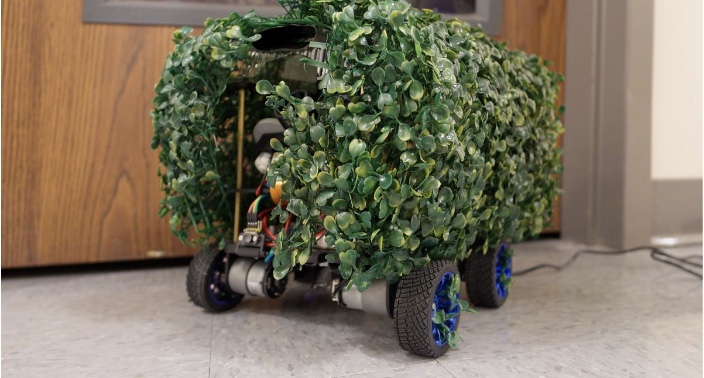
01 / Finished buildView photo ↗
VisionMobileNet-SSDPerson detection
ComputeRaspberry Pi 5Camera + range processing
MotionSTM32Embedded motor control
Demo conditionLive trackingWith a 2-second stationary-person dwell
The goal was to detect a person, keep them centered in the camera view, and maintain a set distance as they moved. I used the Pi Camera 3 for visual input and a time-of-flight sensor for distance feedback, then connected that information to the drivetrain through the STM32.
The demonstration also had a mechanical response: after the person stopped for two seconds, a flywheel mechanism launched foam balls. That made the project about more than following a bounding box—it also involved coordinating perception, movement, and a timed behavior.
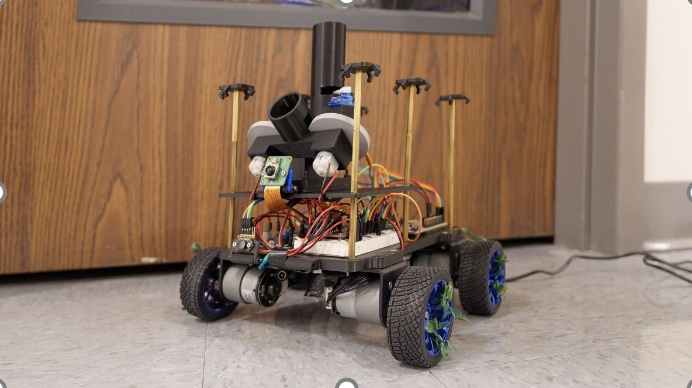
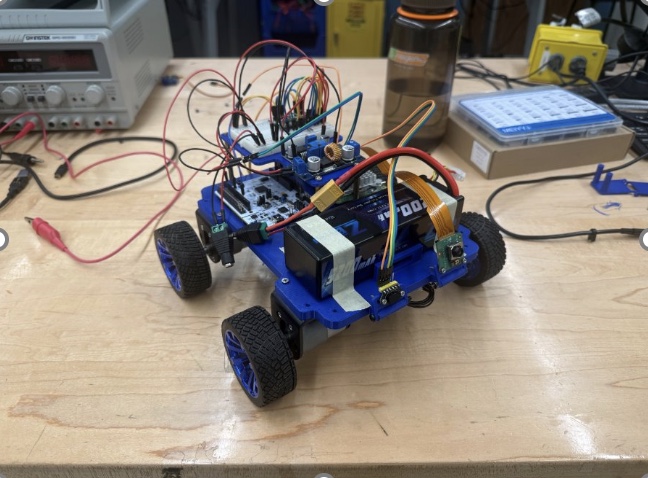
02 / Under the outer enclosure03 / Early hardware integration on the bench
System architecture
Two processors. Different jobs.
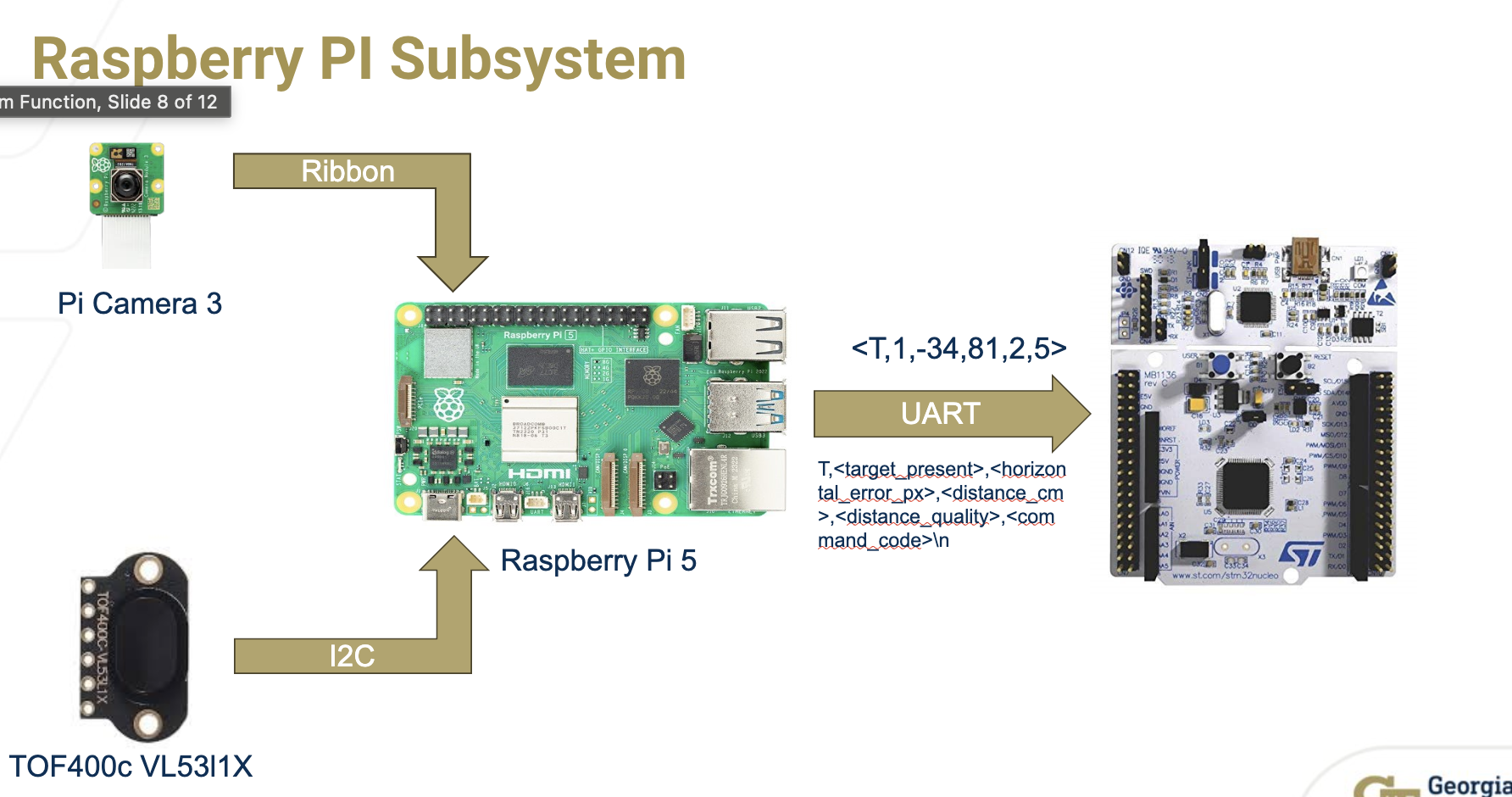
I separated the camera and sensor processing from the physical motor-control layer. The Pi interpreted what the robot was seeing; the STM32 operated the drivetrain and mechanism.
01 / Inputs
Camera + distance
Pi Camera 3 over its ribbon connection. VL53L1X ToF sensor over I²C.
02 / Perception
Raspberry Pi 5
Human detection, tracking information, and interpretation of range measurements.
03 / Handoff
UART
Target presence, horizontal error, distance, measurement quality, and command information.
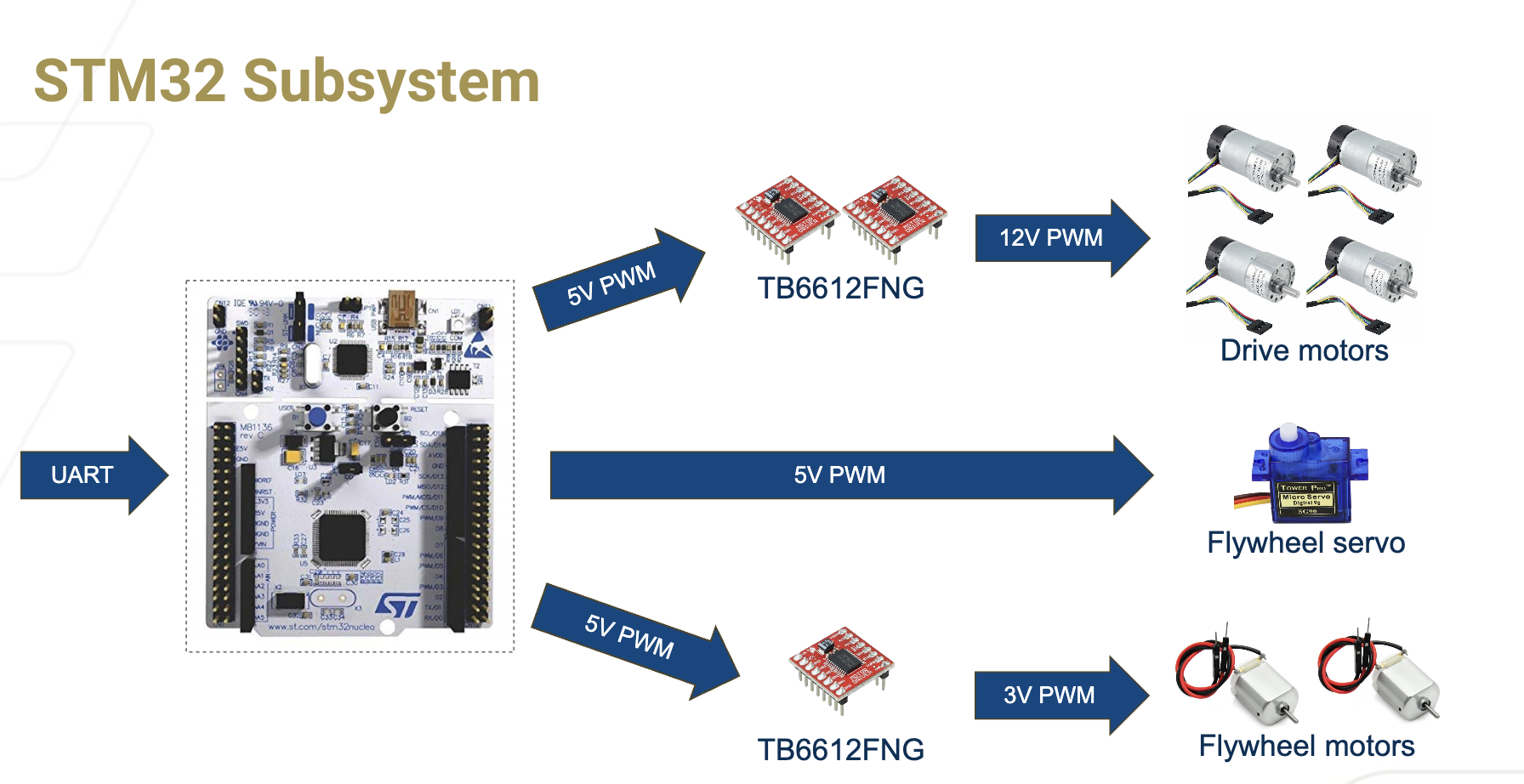
04 / Physical response
STM32
Motor-control outputs through the driver boards, plus coordination of the demo mechanism.
The project presentation identifies TB6612FNG motor drivers in the STM32 subsystem. The diagrams below are the original presentation artifacts, not a verified wiring guide.
Computer vision
The neural network was MobileNet-SSD.
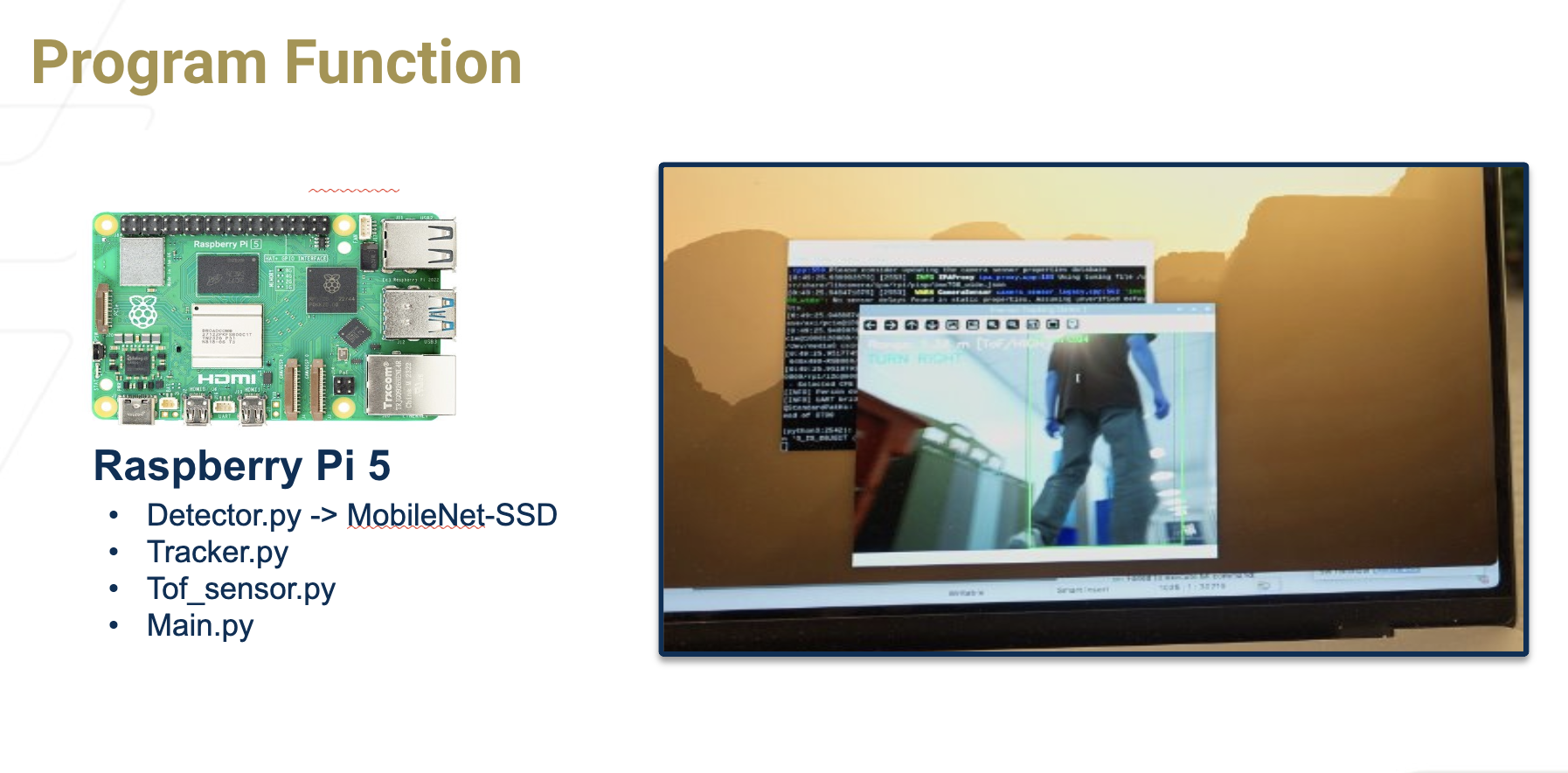
My presentation lists Detector.py → MobileNet-SSD. This was the person-detection part of the system: camera frames went through the detector, and the detected person's bounding box supplied position information for tracking.
MobileNet is a lightweight convolutional neural-network architecture designed for mobile and embedded vision. SSD stands for Single Shot MultiBox Detector; it predicts object categories and bounding boxes in one network pass. Together, they provide a compact object-detection approach.
The original detector/module list and tracking preview. Open to inspect ↗
Detector.pyMobileNet-SSD detection
Tracker.pyTracking layer
Tof_sensor.pyTime-of-flight sensing
Main.pyProgram coordination
Feedback & behavior
Seeing a person was only the start.
Visual feedback
Center the person
The horizontal offset of the detected person's bounding box from the center of the camera view supplied a centering error. As the person moved across the frame, that error supplied the information needed to correct the robot's heading.
Distance feedback
Maintain separation
The ToF sensor added a direct distance measurement. It let the robot maintain a following distance using range feedback, instead of treating the size of a person's image as a distance measurement.
Motor response
PID control
I used PID control to adjust motor response as the tracking error changed. The STM32 operated the motors while the Pi handled the camera and sensor processing. Getting turning corrections to behave well was part of joining those two layers.
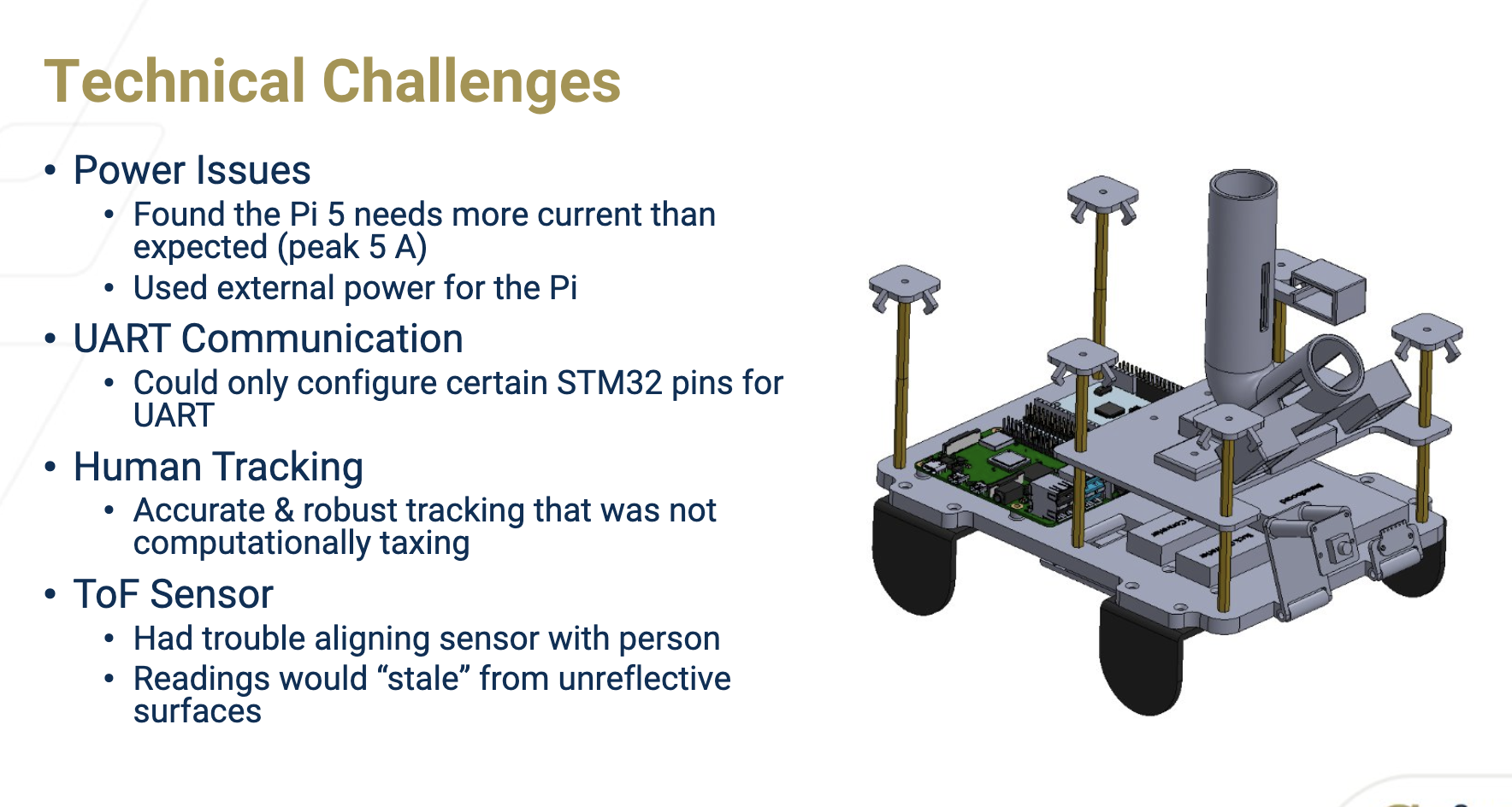
What took work
The integration problems were the project.
01
Power for the Pi
The Pi 5 needed more current than expected during integration. I used external power for the Pi, making power distribution a separate problem from controlling the motors.
02
UART pin configuration
Only certain STM32 pins could be configured for the required UART connection. The communication link had to fit the board's available peripheral configuration.
03
Detection within a compute budget
Tracking needed to be accurate and robust without becoming too computationally demanding. Running the vision work on the Pi made that tradeoff part of the system design.
04
Range alignment and stale readings
The ToF sensor was not always aligned with the person seen by the camera. The presentation also records stale readings on poorly reflective surfaces—finding a person in an image did not automatically mean getting a useful range measurement.
Project documentation
From the original presentation.
Expand a slide, then select it to view the full-size image.
Raspberry Pi subsystem Camera · I²C · UARTSTM32 subsystem Drivers · Motors · ServoTechnical challenges Power · Communication · Sensing
 JOSH MURZELLO